
What it costs · 9 min read
Car door dent repair usually costs between £60 and £350, with simple dings and car park dents at the lower end and creased or side impact damage nearer the top, and a free estimate is the only way to get an exact figure for your car.
To help private drivers with a dented door understand the likely cost range and when the repair might need more than a simple dent removal.
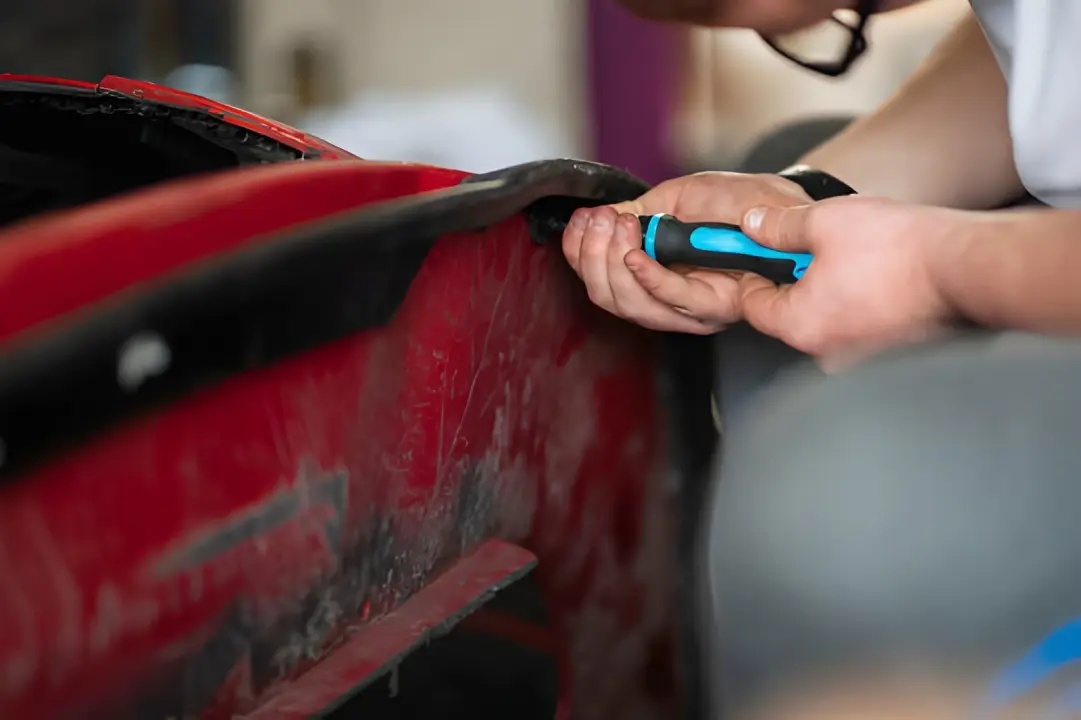
Why doors are often the cheapest panel to fix
Door skins are usually relatively thin, flat panels without the strengthening ribs found under a bonnet or boot lid, which makes them well suited to paintless dent removal when the paint has not cracked. This is one reason door dents are, on average, among the cheaper panel repairs.
When a door is not the cheap option
Doors are not always cheap to repair. A dent along a swage line, a crease running into the door edge, or damage near the handle or mirror mounting can all be harder to correct than a simple flat ding, and side impact protection bars fitted inside many modern doors can limit access from behind for paintless techniques.
Door dings and car park dents
The classic car park dent, caused by another door opening into yours, is usually a rounded shallow dent with intact paint, which is the ideal case for paintless dent removal. These are typically the quickest and cheapest door dents to fix.
Guide prices by damage type
| Damage type | Guide price |
|---|---|
| Small rounded ding, paint intact | £60 to £120 |
| Larger ding or paint cracked | £150 to £280 |
| Crease along a swage line | £220 to £380 |
| Door skin replacement | £300 to £500 |
| Full door replacement and paint | £450 to £750 |
Trim and door card removal
Reaching a dent from behind the panel often means removing the interior door card, window mechanism and any wiring for switches or speakers, then refitting everything afterwards. This adds labour time compared with a dent that can be worked on with the door card left in place, so access is a real factor in the final price.
Side impact bars and creases along a swage line
Many doors have a steel side impact bar running inside them for occupant protection, and this can sit directly behind a dent, blocking the access needed for paintless dent removal. In these cases filler and refinish, or occasionally a door skin replacement, becomes the practical option.
A crease that runs along a swage line, the pressed line running along most doors, is harder to correct neatly because the metal needs to keep its crisp line rather than being smoothed flat. These creases often need more skilled panel work than a simple round dent of the same size.
When a door skin or full door is the answer
- 01If the dent has torn or badly stretched the metal, a door skin replacement is usually more reliable than heavy filler work.
- 02If the door has structural damage, such as a bent frame from a side impact, a full door replacement is often the safer route.
- 03In both cases the replacement panel needs colour matching and blending into the surrounding panels.
- 04We will always explain which of these applies to your car before quoting.
Questions people ask us
- Are car doors always the cheapest panel to repair
- Often yes, but creases along a swage line or damage over a side impact bar can make a door more costly than a simple flat panel dent.
- Will removing my door card add to the cost
- Yes, if the dent needs to be worked from behind, removing and refitting the door card and window mechanism adds labour time.
- Can every door dent be fixed without a respray
- Only if the paint has not cracked and the metal has not stretched too far, otherwise filler and refinish or a new panel will be needed.
- When would a door skin be used instead of dent repair
- A door skin is used when the metal has torn or stretched beyond what filler can correct neatly, which is more common with sharp or deep impacts.
Dent in your car door
Send us a photo and tell us where on the door the dent sits, and we will give you a free no-obligation estimate for the right method.
Door dents at a glance
- Doors are often cheap to repair thanks to their flat, thin panels.
- Swage line creases and side impact bars can push up the price.
- Door card removal adds labour when access is needed from behind.
- Torn or stretched metal points towards a door skin or full replacement.