
Repair or replace · 7 min read
Faded and peeling paint in short
- Fading and peeling are the clear coat wearing out, mostly on sun-facing panels.
- Light surface fading can sometimes be polished; peeling lacquer cannot.
- Peeling panels are sanded back and refinished, with colour matched to the faded car.
- Widespread fading is often better served by a full respray.
How modern car paint is built up
Most modern cars use a base coat for colour and a clear lacquer for gloss and protection. Fading or peeling normally means that lacquer is wearing out.
The roof, bonnet and boot lid face the most sunlight, so they can deteriorate before doors and lower panels and leave the finish looking patchy. Lacquer can also be marked locally by bird droppings and tree sap damage, which is a different problem from general fading.
The stages of paint failure
| What you see | What is happening | Usual fix |
|---|---|---|
| Dull, slightly hazy finish | Surface oxidation of the lacquer | Machine polish may restore the gloss |
| Chalky or milky patches | Lacquer breaking down through its depth | Panel refinish |
| Lacquer lifting or flaking at the edges | Clear coat has lost adhesion | Sand back and refinish the panel |
| Colour looks lighter than other panels | Base coat faded under worn lacquer | Refinish with colour matched to the car |
Can you polish out faded paint?
Sometimes. If the lacquer is still intact and only the very top has oxidised, a careful machine polish can cut back that dead layer and bring the shine back. The limit is thickness: clear coat is thin, and every polish removes a little of it. A panel that has already been polished hard may not have enough left to work with.
Once the lacquer has gone milky through its depth, or has started to lift, polishing will not help and can make the edges of the peeling area worse. At that point the only lasting answer is to remove the failed lacquer and refinish.
Why peeling clear coat cannot be patched
Once a clear coat has started to peel, the surrounding lacquer has usually weakened too, even where it still looks attached. Spraying fresh lacquer over the top of a peeling edge rarely lasts, because the new layer is only as secure as the failing one underneath. The panel needs to be sanded back to a sound surface first.
What a refinish involves
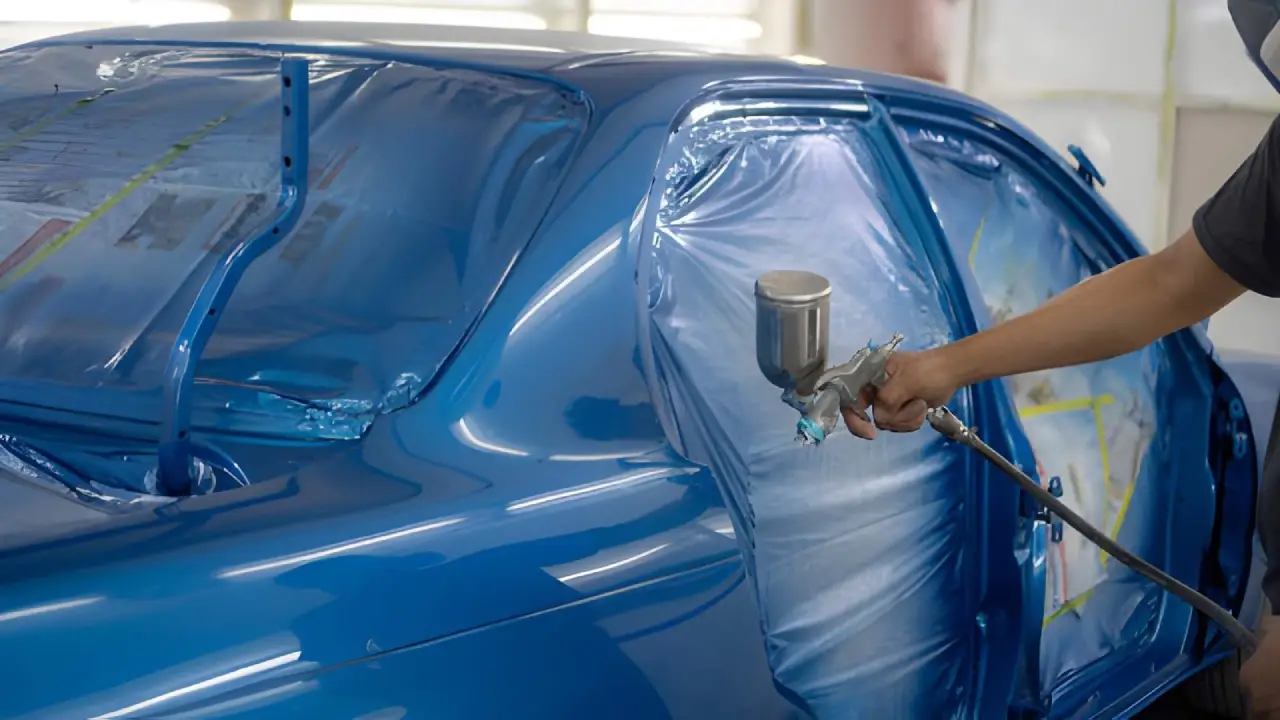
- 01The panel is inspected and the extent of the failed lacquer marked out.
- 02Failed clear coat is sanded back until the surface is sound, and any bare metal is treated and primed.
- 03The colour is mixed to the paint code, sprayed on a test card and adjusted against the car.
- 04Base coat and fresh clear coat are applied, blended into neighbouring panels where needed.
- 05The finish is polished to match the gloss of the surrounding paint.
Matching new paint to a faded car
The surrounding paint may have faded too, so a factory-code mix can look different beside it. Testing the colour against the car, adjusting it and blending into adjoining panels avoids a hard line between old and new paint.
If fading is spread across most of the car, matching panel by panel becomes harder to get right. That is often when a full respray gives a cleaner, more even result than refinishing four or five separate areas.
What decides the cost
- How many panels are affected and how big they are, with roofs and bonnets taking longest.
- How far the failure has gone: polish, single panel refinish or full respray.
- The paint type, as metallic and pearl colours take more care to match and blend than solid ones.
- Whether trims, badges or glass need removing to refinish the panel properly.
- Any rust under failed paint that needs treating before refinishing.
Questions people ask us
- Why is the paint on my roof and bonnet fading first?
- Because they face the sun the most. Ultraviolet light breaks down the clear coat over time, and horizontal panels get far more exposure than the doors and sides.
- Can peeling clear coat be fixed without a full respray?
- Usually, yes. If only one or two panels are affected, each can be sanded back and refinished on its own, with the colour blended into the panels next to it.
- Will a polish fix faded paint?
- Only if the lacquer is still intact and the fading is on the surface. Once the clear coat is milky or lifting, polishing will not restore it.
- Will new paint match a car that has faded?
- It can, if the colour is tested on a card against the car and adjusted for fade, then blended into the neighbouring panels.
- How do I find out what my faded paint needs?
- Send daylight photos of each affected panel on WhatsApp or through the quote form, and we will give you a free, no-obligation estimate.
Where to go next
Lacquer lifting on your car
Send photos of the affected panels and we will tell you whether it is a polish, a panel refinish or a respray, with a free estimate.
Workshop hours
Monday – Friday 8:30am – 6:30pm
Saturday 9:00am – 4:00pm
Sunday Closed
Related guides
Why is it so hard to match my car's paint colour?
Why is it so hard to match my car's paint colour?
Has bird mess damaged my car's paint?
Has bird mess damaged my car's paint?
Do I need a full respray or just one panel?
Do I need a full respray or just one panel?
What does it cost to repair stone chips in my car paint
What does it cost to repair stone chips in my car paint