Repair or replace · 9 min read
Smart repair vs bodyshop repair summary
- Smart repair suits small, localised cosmetic damage
- Full bodyshop repair suits larger areas and structural damage
- Blending is more forgiving across a full panel than a small area
- Smart repairs are quicker and generally cheaper for suitable damage
- Choosing the wrong route for large damage can cost more overall
What each option actually involves
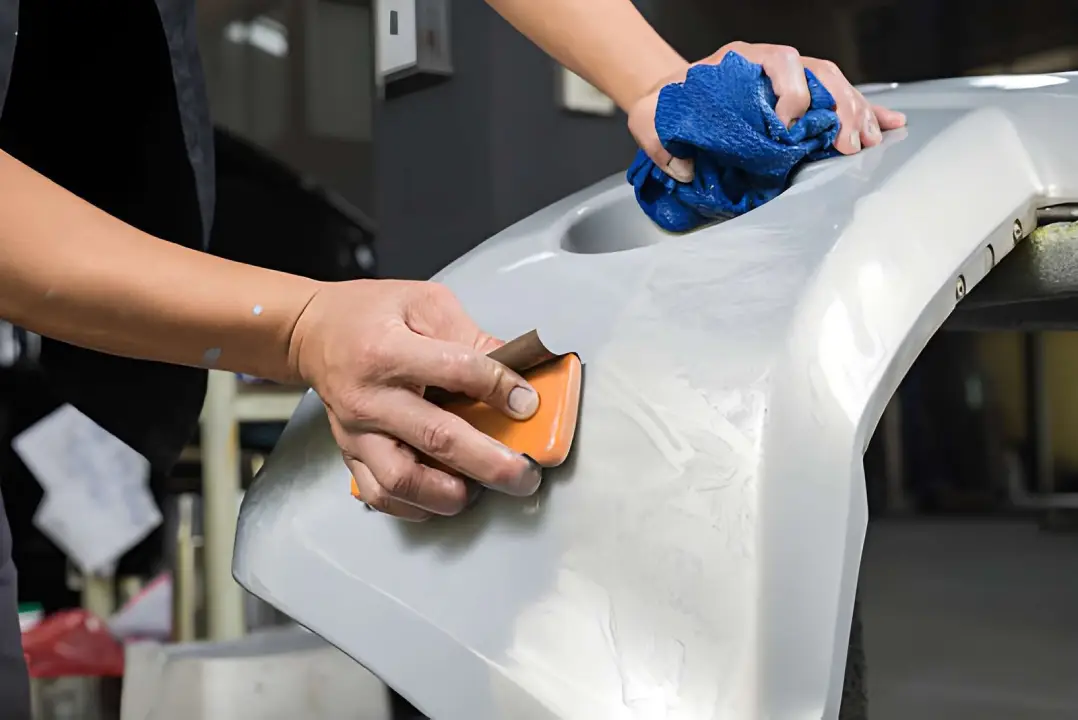
Smart repair stands for small to medium area repair technique, and it describes a set of methods aimed at fixing minor, localised cosmetic damage without the need to remove or fully repaint a panel. It covers things like small stone chips, light scuffs, minor kerb damage to a bumper corner, and shallow dents where the paint is not badly cracked.
A full body shop repair, by contrast, involves removing or masking the panel, carrying out any necessary metal work, priming, and spraying the full panel, often blending into the adjacent panel so the colour match is seamless. It is the appropriate route for larger damage, anything affecting the structure, or where more than one panel is involved.
Comparing the two approaches
| Factor | Smart repair | Full bodyshop repair |
|---|---|---|
| Typical damage size | Small, localised, usually under a hand's span | Larger areas or damage spanning a whole panel |
| Method | Spot priming, blending and touch up techniques | Full panel preparation, priming and spraying |
| Paint blending | Blended into a small surrounding area | Blended across the full panel and often onto neighbours |
| Time off the road | Often same day or very short | Longer, depending on parts and paint drying time |
| Durability | Good for the size of repair it is designed for | Matches the durability of original factory paintwork |
| Cost | Lower for small, appropriate repairs | Higher, but appropriate for the scale of the damage |
Good candidates for a smart repair
- A single stone chip or small cluster of chips on a bonnet or bumper
- A shallow dent with no cracked paint and no sharp crease
- A light scuff on a bumper corner from a low speed kerb knock
- Small scratches that have not gone through to bare metal over a large area
- Minor alloy or trim scuffs alongside the bodywork itself
When a smart repair is a false economy
If the damage spans a large area, involves a crease that has stretched the metal, or the paint has cracked over a wide surface, a smart repair will struggle to blend invisibly and may need redoing sooner than a full repair would have. Choosing the cheaper option in these cases can mean paying twice, once for the smart repair and again for the full repair when it does not hold up or does not match well enough.
Paint blending and colour matching
Blending is where the two approaches differ most. A smart repair blends paint into a small area immediately surrounding the damage, which works well when that area is genuinely small and the base colour is a good match. A full bodyshop repair blends across the entire panel, and often feathers into the next panel too, which gives a more forgiving result on metallic and pearlescent finishes where slight variations in application can otherwise be visible.
Colour matching itself is a separate consideration from which repair method is used, and it depends on accurately identifying your exact paint code and mixing to it. We cover this in more depth on our paint colour matching page, but it is worth knowing that even a well matched colour can look slightly different if blended into too small an area on a difficult finish.
Time off the road and disruption
One of the main appeals of a smart repair is speed. Because the area being worked on is small, the panel does not need to be removed, and drying times are shorter, many smart repairs can be completed in a matter of hours rather than days. A full bodyshop repair takes longer because of the additional preparation, priming, spraying and, where needed, parts ordering involved, though the exact time depends on the extent of the damage and parts availability.
Cost considerations
As an indicative UK guide, smart repairs for genuinely small, localised damage tend to sit at the lower end of repair costs, often a fraction of what a full panel respray would cost. Full bodyshop repairs cost more because of the extra labour, materials and time involved, but they are the right choice once the damage exceeds what a smart repair can properly address. These are only guide ranges, since the actual cost always depends on your vehicle, its paint finish and the specific damage, and a free, no-obligation estimate is the only reliable way to know your figure.
How to decide which you need
- 01Look at the size of the damage, if it is smaller than roughly a hand's span, a smart repair may suit
- 02Check whether the paint is cracked, chipped through to metal, or just surface level
- 03Consider whether more than one panel is affected
- 04Ask whether the repair needs to blend into a difficult metallic or pearlescent finish
- 05Send photos over WhatsApp so we can advise which route suits your specific damage before you commit
Questions people ask us
- Is a smart repair as durable as a full respray
- For the size of damage it is designed to fix, yes, a smart repair holds up well, but it is not intended for larger areas where a full respray would be more durable over time.
- Can a smart repair be used on a metallic paint colour
- Yes, though blending on metallic and pearlescent finishes needs more care, and very small blend areas can sometimes show a subtle difference under certain light.
- How much quicker is a smart repair than a full bodyshop job
- Smart repairs are often completed within hours because the panel does not need removing, while a full repair takes longer due to preparation, priming and paint drying time.
- Will a smart repair be invisible
- On appropriately small, localised damage a smart repair should blend in very well, though results depend on the exact colour, finish and size of the affected area.
- What happens if I choose a smart repair but the damage is too big
- The blend area may be visible and the repair less durable, which can mean paying for a full repair later anyway, so it is worth getting advice before choosing.
Where to go next
Not sure which repair route suits your car
Send us a photo of the damage and we will tell you honestly whether a smart repair or a full bodyshop repair is the right fit, with a free, no-obligation estimate.
Workshop hours
Monday – Friday 8:30am – 6:30pm
Saturday 9:00am – 4:00pm
Sunday Closed